The tools behind the practice
Chakra & Aura Clearing Toolkit
What guided meditation, sound and space-clearing are actually doing in a Reiki practice, and why they’ve become part of the tradition.
Why Guided Meditation
A chakra-clearing meditation exists to give someone a structured way of moving attention through the body, rather than leaving it to wander. It typically follows a simple arc: settling the body, grounding attention at the Root, travelling slowly upward through each chakra in turn, resting at the Crown, and returning attention back down before closing.
The value isn’t really in any single stage — it’s in the pacing. Moving deliberately from one point to the next, rather than skipping ahead, is what gives a person time to actually notice what’s happening in each area, rather than the meditation becoming background noise.
Why Sound Is Paired With Chakras
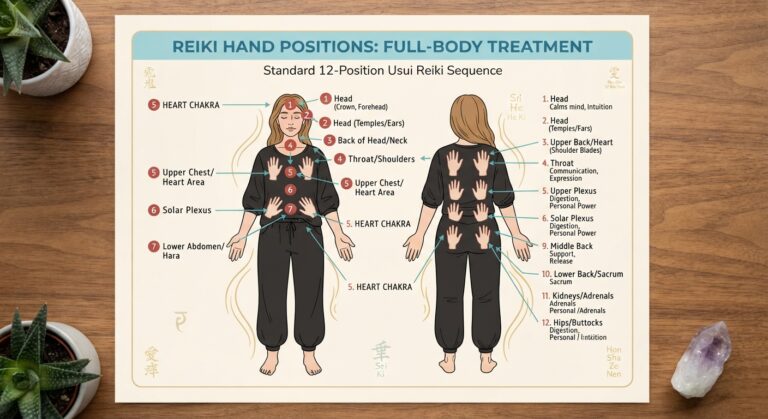
Sound is used alongside Reiki because it gives the chakra system a second, audible way of marking each point — a note or bowl tone standing in for the same seven-part structure already present in the hand positions. The exact note-to-chakra scheme varies between traditions, but a common version looks like this:
| Chakra | Note | Bowl / tone |
|---|---|---|
| Root | C | Low, deep bowl tone |
| Sacral | D | Warm, resonant tone |
| Solar Plexus | E | Bright, mid-range tone |
| Heart | F | Full, open tone |
| Throat | G | Clear, ringing tone |
| Third Eye | A | Higher, focused tone |
| Crown | B | Light, shimmering tone |
Practically, this is why many practitioners favour a single Himalayan or crystal singing bowl played slowly from Root to Crown rather than seven separate instruments — the tone changes, but the underlying idea of moving steadily through the same seven points stays the same.
Why the Space Itself Is Cleared
Reiki treats the treatment room as part of the session, not just a backdrop to it — the idea being that a space can hold onto the residue of whatever happened in it last, in the same way a person can. Clearing it between clients is less about any one client and more about making sure the next person arrives into a space that feels genuinely fresh.
A window opened briefly, clutter tidied and linens reset all serve the same purpose: signalling a clean start before anything else happens. Where herbs are burned, sourcing them ethically matters — culturally significant plants like white sage carry meaning beyond Reiki’s own tradition, which is why alternatives such as rosemary, lavender or cedar are widely used instead.
Moving around the room’s perimeter with smoke or sound is meant to reach corners where stagnant energy is said to collect — the room’s equivalent of the hand positions used on a body. A singing bowl or bell serves the same purpose as smoke for anyone who’d rather avoid it, including clients with respiratory sensitivities.
A short reset between sessions — a bell, an open window, fresh water, a straightened table — exists to mark a clear boundary between one client’s session and the next, for the practitioner as much as the space.
Why Practitioners Personalise These Rituals
None of this is fixed by rule. Most practitioners settle over time on a shortened version — one bowl tone, one clearing habit, one closing gesture — because what matters is that it reliably signals “session over” to both them and their clients, not that it follows any particular script.